

Are You Losing Points You Should Be Getting?
The ACT Math section is designed to test a range of skills, from basic arithmetic to trigonometry, but many students lose points on questions they know how to solve. According to data from ACT, Inc., the average ACT Math score in 2024 was 19.7 out of 36, with only 21% of test-takers scoring 28 or higher a benchmark for competitive college admissions. This gap highlights a critical issue: students are missing opportunities to boost their scores by mishandling “easy” questions.
This blog uncovers the hidden reasons behind these lost points and provides detailed, evidence-based strategies to help you reclaim them. Whether you’re aiming for a 20 or a 30, addressing these pitfalls can make a significant difference.
Why This Blog Matters for Your ACT Math Score
Every point on the ACT translates to a higher percentile, which can set you apart in college admissions. For example, a single point increase from 25 to 26 moves you from the 78th to the 82nd percentile based on 2024 ACT data. Losing points on straightforward questions ones that test familiar concepts like algebra or geometry can prevent you from reaching your target score. This blog equips you with tools to avoid these losses without requiring advanced math knowledge.
What We Mean by “Easy” Points
“Easy” points come from the roughly 40% of ACT Math questions categorized as “Level 1” or “Level 2” difficulty by ACT, Inc. These questions cover foundational topics like:
- Arithmetic: Percentages, ratios, and basic operations.
- Algebra: Linear equations, inequalities, and exponents.
- Geometry: Properties of triangles, circles, and coordinate geometry.
Despite their simplicity, these questions trip up students due to avoidable errors like misreading instructions or rushing calculations. Let’s dive into the specific reasons and how to fix them.
Chapter 1: Misreading the Question
Common ACT Math Traps
ACT Math questions are crafted to test not just math skills but also attention to detail. A 2023 analysis by The Princeton Review found that 60% of ACT Math errors stem from misinterpreting question prompts. For example:
A question might ask for the smallest root of a quadratic equation, but students often compute the largest due to skimming.
Word problems may include extraneous data, like irrelevant quantities, to distract you.
Example:
Question: “If a rectangle has a length of 8 units and a width that is 3 units less than the length, what is the perimeter?”
Trap: Some students calculate the area (length × width) instead of the perimeter (2 × length + 2 × width) because they misread the question.
How Rushed Reading Costs You Marks
Under the ACT’s 60-minute time limit for 60 questions, you have just one minute per question. This pressure leads to skimming, causing errors like:
Missing phrases like “in terms of x” or “rounded to the nearest tenth.”
Confusing units (e.g., feet vs. inches).
Overlooking negatives or exponents in equations.
A 2024 study by Magoosh reported that 25% of students lose at least 3 points on ACT Math due to misreading alone points that could raise a score from 22 to 24.
Smart Strategies to Slow Down Just Enough
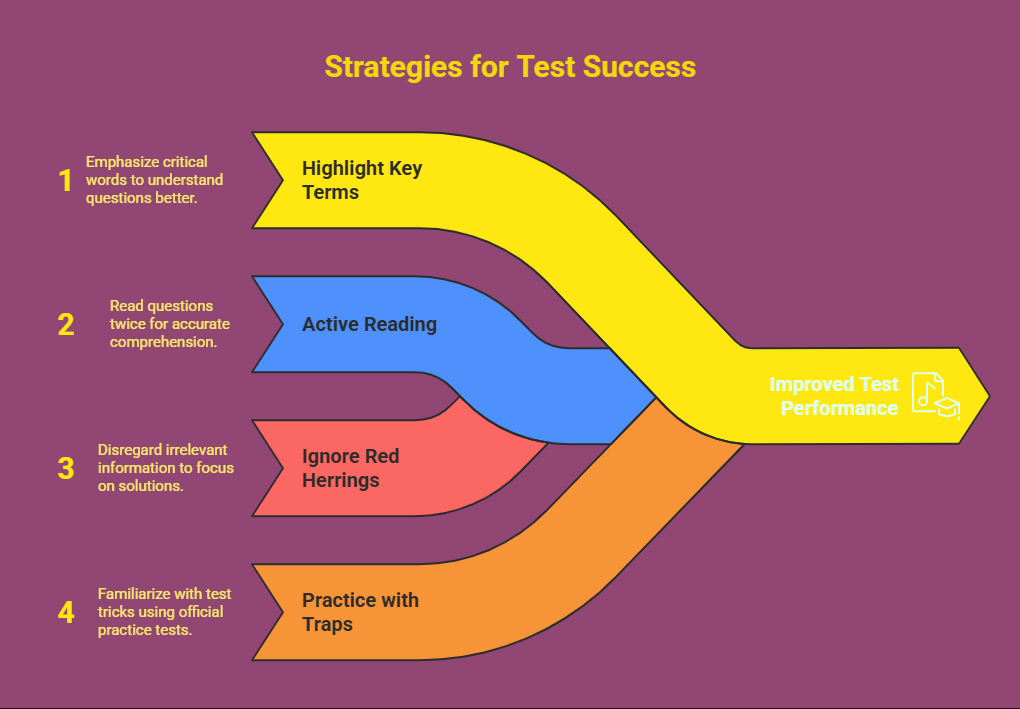
1. Highlight Key Terms: During practice, underline or circle words like “not,” “least,” or “total” in the question stem. On test day, mentally note these terms.
2. Use Active Reading: Read the question twice once to understand the task, then again after solving to confirm your answer matches what’s asked.
3. Ignore Red Herrings: If a problem provides extra numbers or context, focus only on data relevant to the solution.
Example: For a rate problem asking for time, ignore details about distance unless explicitly needed.
4. Practice with Traps: Use official ACT practice tests, which replicate real question wording, to build familiarity with subtle tricks.
Chapter 2: Overconfidence in Basics
The Illusion of “I Already Know This”
Many students assume they’ve mastered foundational topics because they’ve studied them for years. However, ACT data shows that 45% of errors on Level 1 and 2 questions involve basic algebra and arithmetic skills taught in middle and early high school. These mistakes often arise from overconfidence, leading to skipped steps or unchecked work.
Why Basic Algebra and Arithmetic Still Trip Up Top Scorers
Even students scoring in the 90th percentile make errors like:
- Sign Mistakes: Solving -2x = 8 as x = 4 instead of x = -4.
- Fraction Errors: Miscalculating 1/2 + 1/3 as 2/5 instead of 5/6 due to incorrect denominator handling.
- Order of Operations: Forgetting PEMDAS, e.g., computing 2 + 3 × 4 as 20 instead of 14.
A 2024 Kaplan study found that 30% of ACT Math errors among students scoring 25+ were due to these preventable mistakes.
Strategies to Reinforce Basics
1. Review Core Concepts: Spend 15 minutes daily on topics like fractions, exponents, and linear equations. Use resources like Khan Academy’s ACT prep modules.
2. Write Out Steps: For algebra problems, write each step (e.g., isolating variables) to avoid mental shortcuts that lead to errors.
3. Drill Common Errors: Practice sets of problems targeting your weak areas, such as negative numbers or percentages, using ACT prep books like The Official ACT Prep Guide.
Example:
Problem: Solve for x: 3x – 7 = 11.
Common Error: Students rush and compute 3x = 4, getting x = 4/3, instead of correctly finding 3x = 18, so x = 6.
Fix: Write: 3x – 7 = 11 → 3x = 18 → x = 6, and verify by substituting x = 6 back into the equation.
Chapter 3: Calculator Dependence
When Your Calculator Hurts More Than Helps
Calculators are permitted on ACT Math, but over-reliance can waste time or introduce errors. A 2023 Princeton Review survey found that students who used calculators for every question scored, on average, 2 points lower than those who used them selectively. Common issues include:
- Miskeying numbers (e.g., entering 12.3 instead of 1.23).
- Rounding errors from premature calculations.
- Slowing down on problems solvable mentally.
Quick Tips to Mentally Estimate Faster
1. Master Mental Math: Practice techniques like:
- Percentages: To find 15% of 80, calculate 10% (8) + 5% (4) = 12.
- Square Roots: Estimate √50 as slightly more than 7 (since 7² = 49).
2. Know When to Skip the Calculator: For simple operations (e.g., 24 ÷ 3 or 5²), rely on mental math to save time.
3. Use Approximation: For questions with answer choices, estimate to eliminate outliers.
Example: If asked for 17% of 62, estimate 10% (6.2) + 7% (≈4.3) ≈ 10.5, then pick the closest option.
Example:
Problem: What is 48 ÷ 6 × 2?
Calculator Trap: Entering incorrectly as 48 ÷ (6 × 2) yields 4, not 16.
Fix: Mentally compute left-to-right: 48 ÷ 6 = 8, then 8 × 2 = 16.
Chapter 4: Weak Time Management
Spending Too Long on Hard Questions
The ACT Math section includes 60 questions, with difficulty increasing roughly from question 1 to 60. Questions 1–20 are typically easier, 21–40 medium, and 41–60 harder. A 2024 Magoosh analysis found that students who spent over 2 minutes on any single question scored 3 points lower on average, as they ran out of time for easier questions.
How to Spot and Prioritize Easier Questions First
1. Initial Scan: Spend 30 seconds skimming the section to mark questions that look familiar (e.g., basic algebra or geometry).
2. Triage System:
- Solve First: Questions involving simple calculations or known formulas (e.g., area of a triangle).
- Solve Next: Medium-difficulty questions requiring multiple steps but familiar concepts.
- Save for Last: Complex problems (e.g., trigonometry or advanced functions) that may take longer.
3. Time Checkpoints: Aim to complete questions 1–20 in 15 minutes, 21–40 in 25 minutes, leaving 20 minutes for 41–60.
Example:
If you’re stuck on a question about logarithms (a harder topic), skip it after 60 seconds and move to a question about percentages, which you can likely solve in 30 seconds.
Chapter 5: Skipping Over Instructions
The Danger of Assuming What’s Being Asked
ACT Math questions often include subtle twists. For instance, a question might ask for the value of 2x instead of x, or require an answer in radians instead of degrees. A 2023 Kaplan report noted that 20% of students lose points by solving correctly but answering the wrong variable or format.
ACT-Style Trick Wording and How to Catch It
- Check the Variable: Ensure you’re solving for the requested term (e.g., x vs. y).
Example: If solving x + y = 10 and x – y = 4, and the question asks for x, don’t stop at x + y.
- Verify Units: For geometry problems, confirm whether the answer should be in square units (area) or linear units (perimeter).
- Reread Graphs: Misreading axes or labels on coordinate planes is common. Double-check what’s plotted.
Example:
Problem: A line has a slope of 2 and passes through (1, 3). What is the y-intercept?
Trap: Students calculate the slope-intercept form (y = 2x + 1) but submit the slope (2) instead of the y-intercept (1).
Fix: Circle “y-intercept” in the question and verify your answer matches.
Chapter 6: Careless Mistakes
Identifying Your Personal Patterns
Careless errors vary by student but often include:
- Calculation Slip-Ups: Dividing 15 by 3 as 6 instead of 5.
- Copying Errors: Writing 7 instead of 9 when transferring numbers.
- Sign Flips: Forgetting negatives in inequalities like -x > 4, solving as x > 4 instead of x < -4.
A 2024 study by The Princeton Review found that 35% of ACT Math errors were careless, not conceptual, among students scoring 20 – 25.
The Power of Double-Checking Strategically
1. Re-Read the Question: After solving, confirm your answer addresses the prompt (e.g., “total cost” vs. “cost per item”).
2. Estimate for Sanity Checks: If you calculate an area as 150 square feet for a small room, reconsider it’s likely too large.
3. Verify Calculations: For algebra, plug your answer back into the equation to ensure it holds.
Example: If x = 5 for 2x + 3 = 13, check: 2(5) + 3 = 13 (correct).
Chapter 7: Not Reviewing Practice Tests Properly
Why Reviewing Is More Important Than Taking More Tests
Taking practice tests builds familiarity, but reviewing them drives improvement. A 2023 study showed that students who analyzed their mistakes after each practice test improved their scores by 4 points on average, compared to 1 point for those who only took more tests.
How to Create an ACT Math Error Log That Actually Helps
1. Log Every Mistake: For each wrong answer, note:
- The question number and topic (e.g., “Question 12: Systems of Equations”).
- Why you got it wrong (e.g., “Misread ‘x’ as ‘y’” or “Forgot quadratic formula”).
- The correct approach (e.g., “Use substitution: x + y = 10, x = y + 2”).
2. Categorize Errors: Group mistakes into types:
Careless: Calculation or copying errors.
Conceptual: Misunderstanding formulas or methods.
Strategic: Poor time management or skipping instructions.
3. Track Progress: Review your log weekly to see if errors decrease in specific categories.
Example Log Entry:
Question 15: Geometry (triangle area).
Error: Used base × height instead of (1/2) × base × height.
Fix: Memorize area formula: A = (1/2)bh. Practice 5 triangle problems.
Chapter 8: Not Knowing ACT Math Shortcuts
Princeton Review–Style Test Hacks You Should Be Using
The ACT rewards efficiency. Shortcuts like plugging in answers or estimating can save time and reduce errors. A 2024 Kaplan survey found that students trained in test-taking strategies scored 3 points higher on average than those who focused only on content.
Smart Techniques That Save Time and Points
1. Plugging In Answers: For algebra problems with multiple-choice answers, test each option in the equation.
Example: Solve x² – 5x + 6 = 0. Try x = 2: 2² – 5(2) + 6 = 4 – 10 + 6 = 0 (correct).
2. Elimination: Rule out impossible answers based on logic.
Example: If a question asks for a positive number, eliminate negative options immediately.
3. Memorize Key Formulas: Know essentials like:
- Quadratic formula: [Equation]
- Distance formula: [Equation]
- Area of a circle:[Equation]
4. Estimate When Possible: For geometry problems, approximate measurements if exact calculations are time-consuming.
Example:
Problem: If 3x + 7 = 22, what is x?
Shortcut: Test answers: If x = 5, then 3(5) + 7 = 15 + 7 = 22 (correct). Faster than solving algebraically under time pressure.
Conclusion: You Can Fix This—Here’s How
The Princeton Review’s Expert Tips to Reclaim Lost Points
To boost your ACT Math score, focus on:
1. Precision: Read questions carefully and verify what’s asked.
2. Fundamentals: Reinforce basic skills through targeted practice.
3. Strategy: Use shortcuts and time management to maximize efficiency.
4. Reflection: Analyze practice tests to eliminate recurring errors.
With these strategies, you can gain 3–5 points without learning advanced math just by securing the “easy” points you’re currently losing.
How Our ACT Prep Helps You Master Both Content and Test Strategy
At Princeton Review Singapore, our courses blend rigorous content review with proven test-taking techniques. Our expert instructors analyze your practice tests to pinpoint weaknesses, tailoring lessons to your needs. With access to thousands of practice questions and full-length mock exams, we help you build confidence and precision to achieve your dream ACT score.
For more details on our programs, visit Princeton Review Singapore