
If you are thinking about an MBA program, be it in Singapore, America, or Europe, then chances are that you are already familiar with the GMAT test.
But have you tried going through all the information online? There is one thing that stands out—most of the advice seems very technical or just plain vague!
Let’s get things clear.
Here is a guide written to help you in preparation.
What is GMAT (and why does it matter)?
At its most fundamental level, the Graduate Management Admission Test or GMAT is taken up by business schools as a means to test candidates. Gmat assesses your analytical, writing, quantitative, verbal, and reading skills. Business schools around the world use it to test applicants for graduate management programs.
But here’s what actually matters:
It’s not testing how much you studied in university.
It’s testing how you handle information when time is limited.
For example:
- Can you make sense of messy data quickly?
- Can you spot weak logic in an argument?
- Can you avoid traps in seemingly simple questions?
That’s why even strong students sometimes struggle initially—it’s a different way of thinking.
GMAT Examination 2026 – An Overview of the Format
The current format (often called the GMAT Focus version) is quite different from older versions.
Here’s the real picture:
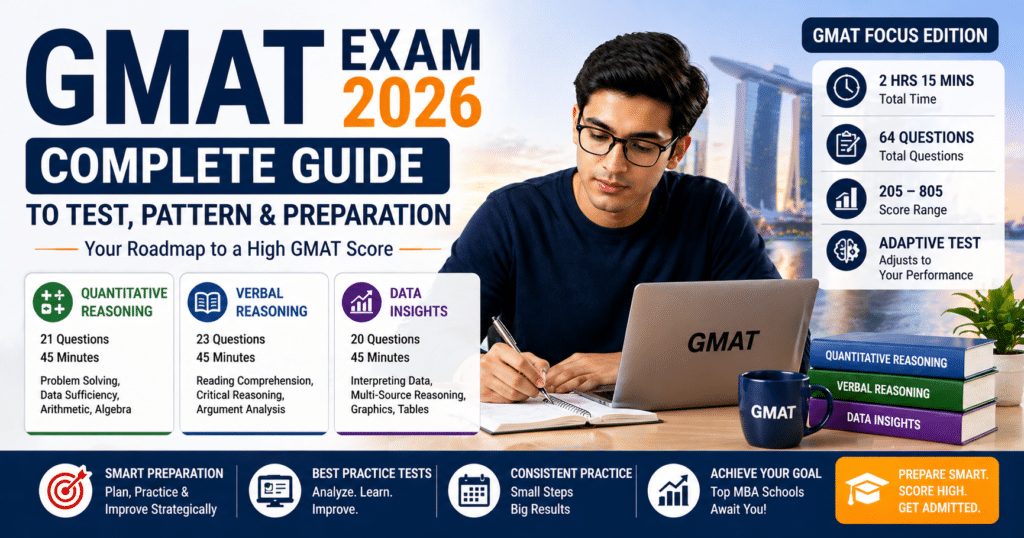
- Total time: about 2 hours 15 minutes
- Total questions: 64 questions
- Sections: 3 main sections
- Score range: 205 to 805
Also:
- The test is adaptive (difficulty changes as you answer)
- You cannot skip questions
- You can choose the order of sections
One thing many students like:
It’s shorter and more focused than before—less exhausting, but more intense.
GMAT Exam Pattern (2026)
Let’s not overcomplicate this. Here’s what each section really involves.
Quantitative Reasoning (21 questions – 45 minutes)
This isn’t about advanced math.
Quant Topics
- Arithmetic basics
- Algebra
- Word problems
- Simple statistics
You’ll often feel like:
“I know this… but what exactly is the question asking?”
That’s intentional.
Verbal Reasoning (23 questions – 45 minutes)
This section checks how clearly you understand ideas.
Verbal Topics
- Reading comprehension
- Critical reasoning
- Argument analysis
It’s less about grammar rules and more about:
“Does this argument actually make sense?”
Data Insights (20 questions – 45 minutes)
This is the most “MBA-like” part of the GMAT exam.
Data Insights Topics
- Interpreting graphs and tables
- Multi-source reasoning
- Data comparison
It’s basically decision-making under pressure—something you’ll do a lot in business school.
When and How to Register
The process to register for the exam is simple. The following points should be followed:
Step 1: Go to mba.com and sign up
Step 2: Fill out your profile correctly
Step 3: Choose the test type (Test Center or Online)
Step 4: Pick your date of taking GMAT 2026 examination
Step 5: Make payment (USD 275)
Step 6: Receive confirmation emailStep 7: Download your appointment confirmation
Eligibility Criteria of GMAT
The eligibility criteria of GMAT are simple and inclusive. Here’s what you need to know:
| Criteria | Requirements |
| Age | Minimum 18 years (13-17 years with parental consent) |
| Educational Qualification | No specific degree required (graduation recommended) |
| Nationality | Open to candidates worldwide |
| Attempt Limits | 5 attempts per year, 8 attempts lifetime |
| Gap Between Attempts | Minimum 16 days |
| Valid ID | Passport (mandatory) |
GMAT in Singapore: What Students Should Know
If you’re preparing in Singapore, your situation is slightly different from students in other countries.
Here’s why:
- You’re likely balancing studies, internships, or work
- Competition is high (especially for top global MBAs)
- You may aim for schools like INSEAD, NUS, or overseas programs
Because of this, many students here prefer:
- Structured timelines
- Guided preparation
- High-quality practice resources
How to Prepare (Realistically)
Let’s keep this practical.
1. Start with a Diagnostic Test
Take one of the best GMAT practice tests early.
Not to score high—but to understand:
- Where you stand
- What feels unfamiliar
- How do you manage time
2. Build Clarity Before Speed
A common mistake:
Jumping into shortcuts too early.
Instead:
- Focus on understanding patterns
- Review mistakes properly
Speed improves naturally later.
3. Follow a Loose Timeline
A realistic plan (based on most students):
- 3–4 months before: Learn concepts, identify weak areas
- 2–3 months before: Practice topic-wise, build a strategy
- 1 month before: Full-length mocks, timing focus
No need to overcomplicate it.
4. Practice Under Pressure
Mock tests are where real improvement happens.
But only if you:
- Take them seriously
- Review them deeply
- Track your mistakes
GMAT Online Coaching vs Self-Study
This depends on your personality.
Self-study works if:
- You’re disciplined
- You enjoy figuring things out
But many students in Singapore choose GMAT online coaching because:
- It saves time
- It gives direction
- Doubts are resolved faster
And if you prefer personal guidance, a GMAT tutor in Singapore can help you stay consistent.
How The Princeton Review Helps in GMAT Preparation
If you don’t want to figure everything out on your own, The Princeton Review Singapore is one of the structured options available.
What students usually find useful:
- Well-organized study plans (no guessing what to study next)
- Access to some of the best GMAT practice tests
- Experienced instructors who simplify tricky concepts
- Flexible GMAT online coaching formats
It makes many people less confused about their preparation.
Mistakes to Avoid (Very Common Ones)
Some patterns show up again and again:
- Taking tests but not reviewing them
- Ignoring weaker sections
- Studying inconsistently
- Focusing only on speed
Fixing these often improves scores more than studying extra hours.
Final Thought
The GMAT feels unfamiliar at the start—that’s the real challenge.
But over time, something interesting happens.
You stop guessing.
You start recognizing patterns.
Decisions become quicker and more confident.
That’s precisely why the test was designed.
If you stay consistent and keep your preparation honest, the score follows.
Not instantly—but steadily.