
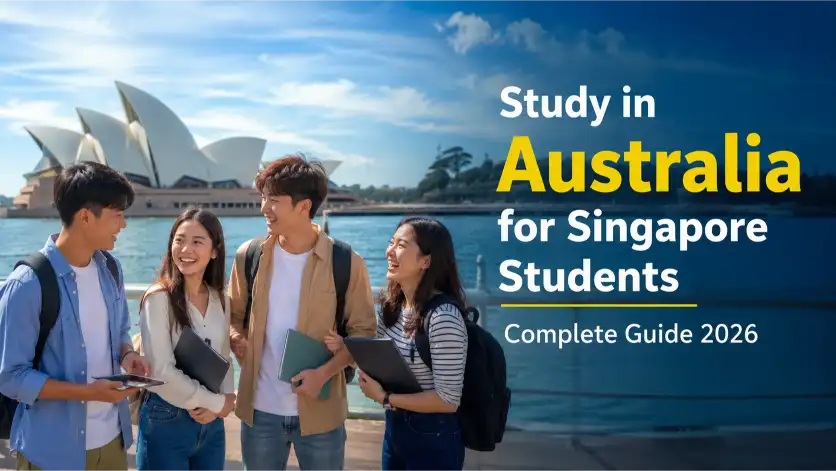
A Singapore student told me this before she left for Perth.
“I thought moving overseas would feel dramatic. Honestly, the weirdest part was learning how expensive blueberries are.”
She wasn’t wrong.
The degree matters, sure. But ask anyone who studied abroad, and they don’t lead with that. They lead with the grocery store panic. They fixed the broken heater themselves. The semester they stopped calling home every single day, and didn’t notice until much later.
Australia has a way of doing that to people. Not dramatically. Just gradually, through ordinary inconveniences that slowly stop feeling like problems.
For 2026, start sorting the paperwork now. Transcripts go missing. Recommendation letters get delayed. Visa timelines shift. The students who begin early don’t have better luck — they just have more time to deal with the boring stuff before it becomes urgent.
Why Australia Remains Popular With Singapore Students
The first thing parents notice is the flight time.
Four to five hours, depending on where you’re headed. Same rough time zone. It sounds like a small thing until you compare it to a child living in Manchester or Boston, and suddenly Perth feels practically next door.
Students settle in quicker, too. Melbourne, Brisbane, Perth — these aren’t cities where an Asian face is unusual. The food options exist, the communities are already there, and the adjustment period is shorter than most families expect going in. University of Melbourne and QUT pull a lot of Southeast Asian students specifically because they’ve built for that — international intakes, industry ties, campuses that don’t feel like you landed on another planet.
The classroom is where Singapore students get the real surprise, though.
Back home, most are used to structured environments. Clear instructions, defined expectations, and teachers who lead. Australian tutorials don’t always work like that. Lecturers ask open questions and then just wait. They actually want an answer. From you. Unrehearsed.
Some students love it immediately. Others spend the first semester convinced they’re about to say something embarrassing every time a professor looks their way. Most get there eventually. It just takes a few weeks of realising nobody in the room has it figured out either.
Courses That Continue to Attract Students
Business still gets the most applications. That hasn’t changed.
What has changed is everything around it. Computer science, cybersecurity, health sciences, engineering — these fill up fast now in a way they didn’t earlier. Psychology and design are steady. Finance isn’t going anywhere.
The interesting shift is with technology. Students who would never have called themselves technical five years ago are now actively picking programs because they want those skills. Not instead of what they originally wanted to study — alongside it. A marketing graduate who can also work with data is a different proposition to an employer than one who can’t. Australian universities make that combination surprisingly easy to put together.
The question students used to ask was “What do I want to study?” The one most are asking now is “what do I actually want to be able to do?” Those two questions don’t always have the same answer. Worth figuring out before committing to a program.
Understanding Admission in Australia
Most universities run two intakes — February and July.
February is the bigger one. More courses available, larger cohorts, and generally more scholarship rounds tied to this intake. If that’s the target, the groundwork realistically starts now — not three months before the deadline.
That sounds early until you actually start collecting documents.
Transcripts need to be requested, sometimes from multiple institutions. Recommendation letters depend entirely on someone else’s schedule. Passports expire at inconvenient times. Health insurance paperwork sits in an email until suddenly it’s urgent. None of these things is complicated individually — they just all take longer than expected, and they all land at the same time if you leave them too late.
The July intake exists and works fine for plenty of students. But if February 2027 is the goal, mid-2026 is when the sorting should start — not October.
Eligibility Requirements
Study in Australia from Singapore follows a broadly consistent pattern, though every university sets its own bar, so check individually.
Undergrad applicants from Singapore usually come in through A-Levels, a poly diploma, or IB. Australian universities know these qualifications well. Nothing unusual there.
Postgrad needs more paperwork — transcripts, a CV, recommendation letters, and a statement of purpose. Some programs want an interview on top of that, or evidence you’ve actually worked in the field before. Read the fine print for whatever you’re applying to.
The statement of purpose is where most students waste the most energy.
They write what they think an admissions officer wants to hear. It ends up sounding like every other application in the pile. The ones that actually get remembered are specific — a particular reason for choosing that program, a genuine interest that shows up clearly, something that couldn’t have been written by anyone else applying that year. Impressive vocabulary doesn’t do that. Honesty usually does.
Tuition Fees and Daily Expenses
The cost of studying in Australia is the number everyone researches, but living costs are what actually surprise people.
Business degrees run roughly AUD 30,000–45,000 a year. Engineering sits between AUD 35,000–50,000. Arts and humanities come in a bit lower, usually AUD 25,000–40,000. Check directly with your university for exact figures as fees are updated annually.
What catches students off guard is everything else.
Sydney and Melbourne are expensive cities even for locals. Rent alone can hurt if you’re not careful about where and how you live. The students who manage best usually figure out early that sharing a flat with two or three others isn’t a compromise — it’s just the obvious move. Same with cooking at home most nights, hunting down second-hand textbooks, and actually using the student transport discounts that most people forget exist.
None of that is glamorous advice. But the difference between a student who tracks small expenses and one who doesn’t tends to show up clearly by the second semester — usually when one of them is stressed about money and the other isn’t.
Scholarships for Singapore Students
Scholarships exist and are worth looking into — but go in with realistic expectations.
Most universities offer something for international students. Merit-based awards, grants tied to nationality or region, and research funding for postgrad applicants. The range is genuinely there. The competition for the better ones is also genuinely real, so treating a scholarship as a backup plan rather than a given is the smarter position. Students who invest in test prep early tend to present stronger applications overall, which matters when scholarship competition is real.
That said, partial scholarships are underrated. Students often dismiss anything that isn’t a full ride. But shaving AUD 5,000 or 8,000 off a three-year degree adds up to something meaningful — especially when living costs are already stretching the budget.
Look at what each university specifically offers for Singapore and Southeast Asian applicants. Some have dedicated awards that don’t get much attention simply because students don’t dig far enough into the university website to find them.
Student Visa Process
Every international student needs the Student Visa — Subclass 500. The steps follow a set order:
- Confirmation of Enrolment comes from the university first — nothing else moves without it
- Overseas Student Health Cover gets sorted next — mandatory, not optional
- Financial documents need to be ready to show that you can actually support yourself there
- Then the online application goes in
One thing that catches people off guard — the visa assessment includes a Genuine Student requirement. Applicants need to show that studying is the primary reason for going, not just a pathway to staying long term. It’s assessed during the application, so worth thinking about before submitting.
Visa processing times also shift depending on the season. A November applicant chasing a February intake is in a very different position than someone who applied in August. Leave room for things to move slowly, because sometimes they do.
What Student Life Is Actually Like
The photos look great. Everyone’s at a beach or a night market or somewhere with good skyline views.
What doesn’t get posted is the week when three things broke at once. The landlord wasn’t responding. The assignment was due Friday. The bank card stopped working for no clear reason. That week exists for almost every student who goes. Usually in the first semester.
And that’s the part nobody really prepares you for — not because it’s devastating, but because it’s just a lot of small things hitting at the same time with nobody nearby to split it with.
Most students get through it fine. They figure it out, things settle, and life starts to feel less like an obstacle course. But somewhere in that process, something shifts. Hard to name exactly. They just stop needing things to be sorted out for them.
How The Princeton Review Singapore Can Help
Navigating admission in Australia means managing a lot of moving parts — and it’s easy to miss something when you’re doing it alone.
The Princeton Review Singapore works with students across the different stages:
- Test Prep Online for SAT, ACT
- Test Prep for IELTS
- University shortlisting
- Admission counselling
- Application guidance
- Interview preparation
Having someone who has seen the process many times over makes a real difference — not just for keeping things organised, but for catching the small mistakes that tend to show up when deadlines get close.
Final Thoughts
Nobody moves to another country and comes back the same person.
That sounds obvious until you actually watch it happen — a student who once needed reminders to pack lunch is now negotiating lease agreements, filing tax returns, and cooking passable meals on a Tuesday night.
Australia does that quietly. The degree gets finished, the grades come in, and somewhere between the first confused week and the final semester, something shifts.
Most graduates will forget which textbook covered which topic. They won’t forget the first time they handled a problem entirely on their own, far from home, with no one else to sort it out for them.
That part stays.