
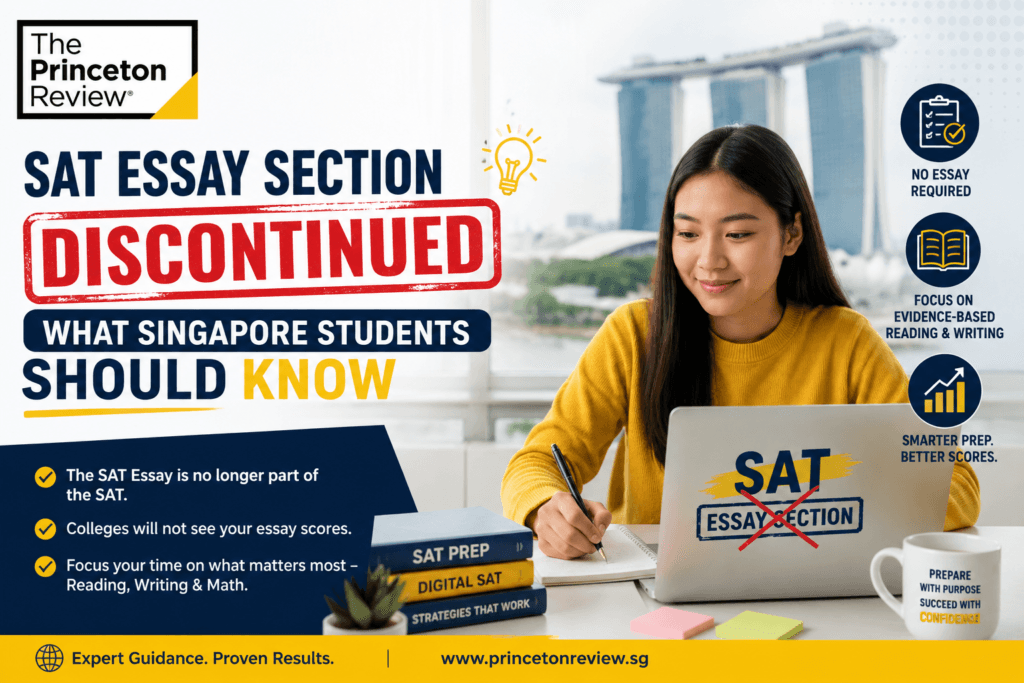
For those whose children have been taking SAT preparation classes and whose checklist contained the writing portion in red, here is one thing to remember: It does not exist anymore! Indeed, as of June 2021, it has been made official that the SAT Essay is no longer conducted. This is especially pertinent for those Singaporean students applying to US colleges.
But why? So, let’s delve into its implications.
Why Was the Essay Removed?
The College Board did not pull the essay section on a whim. Over several years, research showed that very few colleges used SAT Essay scores in meaningful ways during admissions. Many universities had already quietly made it optional — and then simply stopped looking at it altogether.
The essay required students to read a passage and analyse how the author built their argument — a valuable skill, no doubt. But the scores were proving inconsistent and difficult to interpret across different testing sessions. When even top universities like Harvard and Stanford stopped requiring it, the writing was, quite literally, on the wall.
So in June 2021, the College Board phased it out entirely from the standard SAT. What remained is a focused, streamlined exam: Reading and Writing, and Math.
What This Means for Singapore Students
Singapore students are no strangers to high-stakes exams — the pressure of O-Levels and A-Levels is real. Many families exploring US admissions alongside local pathways often treat the SAT as one more test to master from top to bottom. Historically, the essay section added both prep time and stress to that burden.
Its removal is, in many ways, a relief. But it also reshapes where you should direct your energy.
Here is what changes for you:
The SAT is currently a test out of 1600.
There is no optional essay, nor a writing supplement. Your score sheet will include only your Math and Evidence-Based Reading and Writing, renamed to Reading & Writing on the new digital SAT. There isn’t a single admissions officer who is looking for your nonexistent essay score.
If you have been using older prep books — anything published before 2022 — be especially careful. Many of those books still include essay prompts and scoring guides as if the section is live. It is not. Using outdated materials could mean spending weeks practising something that simply will not appear on test day.
Does This Mean Writing Skills Don’t Matter Anymore?
Not at all — and this is where many students get confused.
The SAT essay is gone, but your writing ability remains central to your college application in every other way. US universities still expect compelling personal essays through the Common App or Coalition App. These supplemental essays could be up to five at a time, and here’s where your unique voice needs to come through.
The idea here is simple: in the old days, people would spend weeks studying a timed analytical essay, which got reduced to a single subscore number. Today, the focus should be on writing that compelling personal statement, which is actually being read by someone.
When you’re applying to top-notch schools like NYU, UMich, or USC, schools where many Singaporean applicants are applying, your supplemental essays will either help or hinder your application process. That is where your writing needs to be excellent.
The Digital SAT: What’s Actually Changed
In March 2023, the College Board rolled out the digital SAT internationally — Singapore students were among the first to take it in this new format. The shift brought significant structural changes worth knowing:
1. Shorter test duration: The digital SAT takes about 2 hours and 14 minutes, compared to nearly 4 hours for the old paper version (with essay). Students report less fatigue.
2. Adaptive testing: The overall ‘level of difficulty’ of the Digital SAT is based on how well or how poorly you do in module 1. If you do well in module one, you can receive harder, higher-scoring questions in the second module.
3. Shorter reading passages: Gone are the long, multi-paragraph passages. Questions now come with shorter texts, each paired with a single question — making comprehension faster but still demanding.
4. Built-in calculator throughout Math: Students can use the Desmos calculator for all math questions, which changes how they approach certain problem types.
The redesign is meaningful — this is not simply the old SAT moved onto a screen. Prep strategies need to reflect the new structure.
How The Princeton Review Can Help
Doing everything yourself in this regard, especially if you are from Singapore, which might appear intimidating to you, is not easy at all. It would help to understand what services The Princeton Review offers.
The Princeton Review’s SAT prep course is designed keeping in mind the new SAT, which now exists in the digital world. They have revised their classes to take into account how the test now adapts itself based on your responses, the reduced size of passages, and the fact that there is no essay anymore.
What sets their approach apart is the diagnostic depth. Before you start drilling practice questions, their programmes identify exactly where your scoring gaps are — whether that is command of evidence questions in Reading and Writing, or multi-step word problems in Math. That kind of targeted preparation is far more efficient than a generic review, especially for Singapore students balancing school commitments alongside SAT prep.
Not just for the tests themselves but also in the realm of college admissions, The Princeton Review assists with essay writing, whether it be your personal statement essay or any other supplement essay you need to complete. Since SAT essays are no longer being written, getting help with your college essay really counts.
For those who prefer having options, their online and on-demand offerings make sure that you don’t have to follow a fixed schedule. If you would rather have more structure, their live classes will allow you to learn in real time.
Practical Tips for Singapore Students Preparing Now
Get rid of your old study material right away: If your book was written before 2023, chances are that it will include essays, long readings, and old-fashioned questions. Switch to current resources that reflect the digital SAT.
Use Bluebook for official practice: The College Board’s free Bluebook app delivers full-length adaptive practice tests in the exact format you will face on test day. There is no substitute for practising in the actual environment.
Redirect writing energy toward application essays:
Time that used to go toward SAT essay prep can now go toward drafting and refining your personal statement. Start early — most students underestimate how many drafts a strong application essay requires.
Know your target score range by university: Different US universities weigh the SAT differently. Check out each school’s Common Data Set (available publicly online) to find out what the middle 50% of accepted applicants scored – that’s what you’re shooting for, not just some “the higher the better” mentality.
The Takeaway
The elimination of the essay section of the SAT is not an inconsequential detail, but rather a structural change to the test itself. For students from Singapore taking the SAT, it is a positive development for several reasons, not the least of which is that it makes the test shorter and more targeted.
But the energy you save by not preparing for a phantom essay section should go somewhere — specifically, into mastering the digital SAT format and building the kind of authentic, specific application essays that actually move an admissions committee.
The students who do well in this environment are not necessarily the ones who work the hardest — they are the ones who work on the right things. Now you know what those things are.