
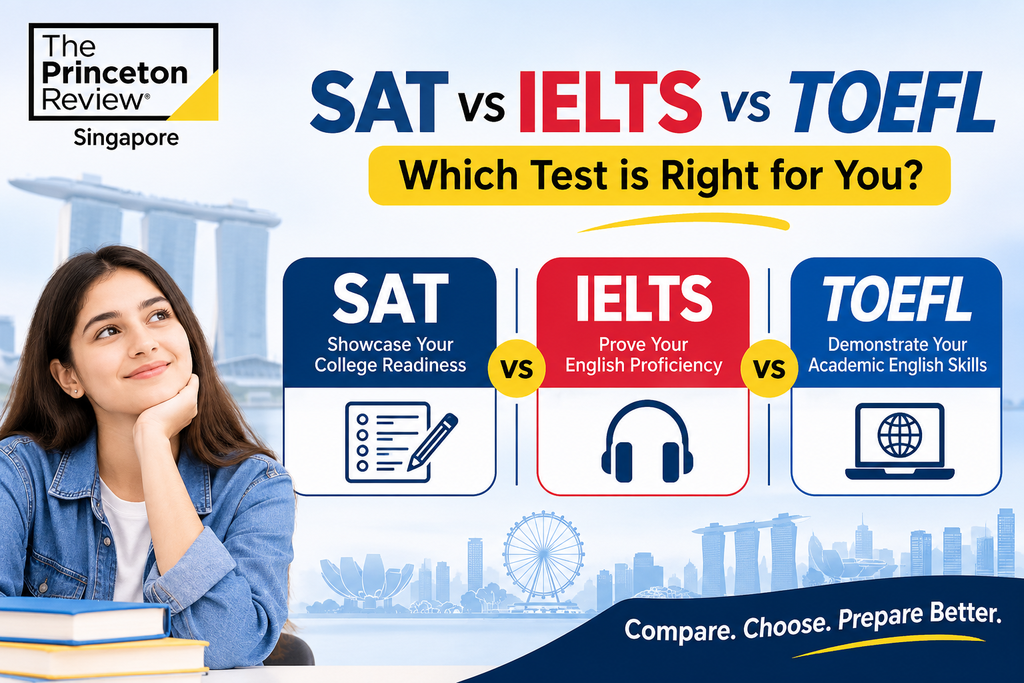
I must tell you the truth – when my neighbour’s son decided that he wanted to study engineering in America, she turned to me, absolutely in a state of shock. On two evenings, she was lost in the world of Google, with four windows open and three contradictory opinions; she got a terrible headache. “Should I pass the SAT, TOEFL and IELTS? Or just one? Which one? And what even is the ACT?”
I made her tea, and we sat down and sorted through it together. That is about the same message that I conveyed to her at that time.
It is quite natural that there should be confusion regarding these tests because people tend to put them in the same list without understanding that each one of them checks something totally different.
The SAT Has Nothing to Do With English Proficiency
I want to lead with this because it’s where almost everyone gets confused first.
The SAT is not a language test. It was never designed as one. The College Board created it to assess whether a student — any student, from anywhere — is academically ready for university-level study. A kid from a rural area and a kid from suburban Ohio sit the same test. There’s no native-speaker advantage built into it. It has a Math section and a Reading & Writing section, and a total score of 400 to 1600.
Since 2024, the SAT has been fully digital. Taken on an app called Bluebook. Runs just over two hours. The format is adaptive, which means if your child does well on the first module, the second gets harder — and scoring well on a harder module earns more points. It’s a bit like a video game difficulty curve, except the stakes are somewhat higher.
Here’s something parents consistently overlook: not every US university requires the SAT. After COVID-19, a wave of schools went test-optional, and many of them stayed that way. But the tide has started turning again — MIT, Yale, Dartmouth, and others have brought back score requirements. So you can’t assume. For every school on your child’s list, you need to go to that school’s admissions page and check what’s currently required. Not a third-party site. The actual university page. Policies are changing, and third-party info goes stale fast.
TOEFL: The Older, More Established English Test
TOEFL — Test of English as a Foreign Language — does exactly what the name says. It is designed to evaluate applicants who are not native English speakers in order to determine if they are able to attend lectures, seminars, and write papers in English.
This exam is administered by the Educational Testing Service (ETS). Four sections: Reading, Listening, Speaking, Writing. Out of 120. The version students take now is called the TOEFL iBT (internet-based test), and ETS shortened it in 2023, dropping it from nearly three hours to roughly two. One reading passage gone, one listening section gone, the old independent writing task removed. It’s leaner now, though no less demanding in terms of what it actually tests.
The listening content is worth flagging specifically. The passages mimic American university lectures — professors talking about plate tectonics, the history of the printing press, and behavioural economics. The accent used in TOEFL is the American accent. In case you have studied through the British English program, you may find the TOEFL listening section very surprising when you attempt it for the first time. However, that should not be an excuse to not take it up.
Most universities would be looking for scores ranging between 100 and 110 in the case of the TOEFL iBT test. Some universities may quote the exact cut-off, while others simply mention “competitive”. A 100 is a reasonable floor to aim for if you’re targeting decent universities. There’s also a TOEFL Home Edition if your child prefers not to test at a centre.
IELTS: Genuinely Different, Not Just a British Knockoff
People often assume IELTS is just TOEFL with a British accent. That’s underselling what makes it different.
IELTS Academic — and I want to stress Academic, not General Training, which is for immigration and work visas, not university applications — is accepted at thousands of US universities and scores on a band scale from 1 to 9, in 0.5 increments. Most competitive programs want a 7.0 at a minimum. Some want 7.5. A handful of really selective programs want higher still.
The detail that matters most here is the Speaking section. In TOEFL, your child sits alone, gets a prompt on screen, and records a response into a microphone with no human feedback. In IELTS, a trained examiner sits with them — in person or via video — has an actual conversation, asks follow-up questions based on what they say, and scores them on fluency, vocabulary, coherence, and pronunciation.
That is a fundamentally different experience. For students who are naturally good communicators — people who think quickly in conversation, who warm up when they’re talking to someone rather than reciting into a void — IELTS Speaking often produces much stronger results. I’ve known students who were intermediate English speakers but genuinely personable and got a 7.0 on IELTS Speaking because they could hold a real conversation. The same students froze on the TOEFL’s speaking tasks.
IELTS is offered on paper or computer. British Council and IDP both run test centres, dates are frequent, and in most Indian cities, you won’t struggle to find a slot.
Which Does Your Child Actually Need? Here’s the Real Answer.
It depends on two things: where your child went to school, and which universities they’re applying to.
Scenario one — your child has studied in English their entire academic life. Many US universities will waive the proficiency test requirement entirely. Some want proof: four consecutive years in an English-medium school, documented. Some use the SAT’s Reading section as a proxy. Some are fine with a letter from the school. Check each university’s waiver policy directly — they’re not all the same.
Scenario two — English isn’t the language your child has been taught in. Then yes, plan for a proficiency test. But only one — TOEFL or IELTS. They measure the same thing, they’re accepted at the same schools, and doing both is usually just doubling your cost and prep time for no benefit. Pick one. Commit. Prepare properly.
Secondly, and independently, decide whether you need to take the SAT or ACT. All those institutions requiring it accept both exams.
Therefore, in the most usual case for international applicants, one test for language proficiency (TOEFL/IELTS) and one test for aptitude (SAT/ACT). Two tests, not four.
Picking Between TOEFL and IELTS
Since both land at the same doors, this is entirely a question of your child and the format.
The Speaking section is the biggest practical split, as I mentioned. But there are a few other things worth thinking about.
Test centres and availability — in some cities, IELTS has more slots and more dates. If your child is working around board exams or visa timelines, this actually matters. Check what’s available near you before committing.
The texture of the content — TOEFL is very American academic in its feel. If your child has been reading and listening to British or Indian academic content, IELTS might feel like home turf, even though that’s not its literal origin.
And honestly? Have your child do one official practice section of each. Not a full test — just one section. The one that feels less disorienting is usually the right starting point.
The ACT Gets Less Attention Than It Deserves
Outside the US, the SAT gets talked about far more than the ACT. But they’re equally accepted at American universities, and for some students, the ACT is genuinely the better fit.
The ACT has four sections: English, Math, Reading, and optional Science and Essay Sections. Score out of 36. The Science section is where most international students hesitate, but it’s not actually a science content test — it’s a data interpretation and reasoning test dressed up in science clothing. Students who are comfortable reading graphs and tables and drawing conclusions quickly often find the ACT clicks in a way the SAT doesn’t.
Both the College Board and ACT Inc. publish free official practice tests on their websites. Worth having your child try one of each before committing to months of prep for a test that might not play to their strengths.
At a Glance
| Test | What It Measures | Who Needs It | Score |
| SAT | Academic readiness for college | All applicants (where required) | 400–1600 |
| ACT | Academic readiness for college | All applicants (where required) | 1–36 |
| TOEFL iBT | English language proficiency | Non-native English speakers | 0–120 |
| IELTS Academic | English language proficiency | Non-native English speakers | 1–9 bands |
Where The Princeton Review Singapore Comes In
Knowing which tests your child needs is step one. Actually preparing well for them is the whole rest of the climb.
The Princeton Review has been in this space since 1981. The reason why hardworking students opt for these classes year after year is that the preparation is based on how each test is scored, not merely on the topics it assesses. Regarding the SAT and ACT, it means that it is necessary to understand the reasons behind incorrect answers rather than to know the information itself. As for TOEFL and IELTS, it implies learning the exact techniques that bring scores in the Writing and Speaking sections.
For families outside major cities, their online courses and tutoring make high-quality prep accessible without having to travel. Their diagnostic tests are useful early on — they show you exactly where your child is losing marks, so prep time goes to the right places instead of spreading thin across everything. Given that most students are simultaneously dealing with school exams, extracurriculars, and application essays, that kind of targeted efficiency genuinely matters.
Head to princetonreview.sg to look through what they currently offer for your child’s specific tests.
Before You Move On
Do this one thing tonight: write out your child’s target schools — even a rough list — and spend twenty minutes looking up the admissions requirements for each. Go to the official admissions page, not a forum, not a ranking site.
You’ll almost certainly find the picture is more manageable than the internet made it seem. Most international applicants end up needing two tests. The prep is real and takes time, but it’s not mysterious. Give your child a few months of solid preparation, the right resources, and a realistic timeline — and the scores will come.
The students who struggle aren’t usually the ones who weren’t smart enough. They’re usually the ones who started too late.
Check out – IB Tuitions