
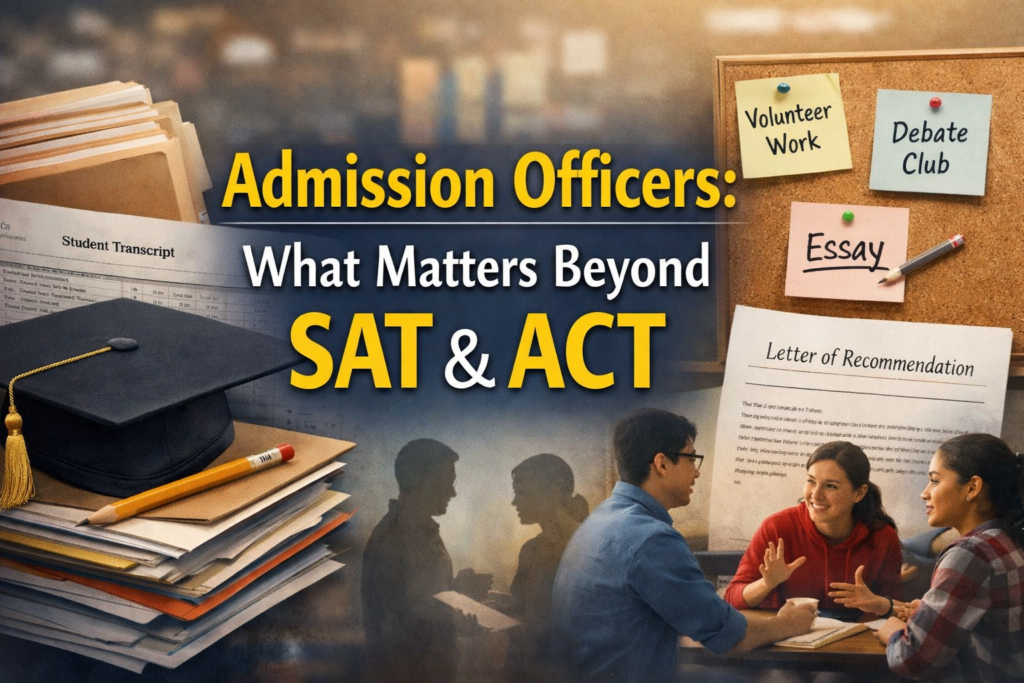
There’s a moment in almost every admissions cycle when SAT and ACT scores stop being discussed.
It doesn’t happen publicly. There’s no announcement. It’s just the point when the numbers have already done what they can do. They’ve answered one narrow question: Can this student handle the academic baseline here?, and then they quietly step aside.
Everything that follows is more human.
Admission Consulting officers don’t spend their days debating tiny score differences. Once a student is academically viable, the real work begins. And that work looks less like math and more like judgment.
The Transcript Is Read Like a Story, Not a Spreadsheet
Grades matter, but only in context. An admissions officer doesn’t see “AP Chemistry: B+” and moves on. They wonder why it’s there. Was it optional? Was it a reach? Was it a weak year or a strong one?
Patterns are more important than individual data points. Is the student a risk-taker who has attempted challenging courses, changed courses, had setbacks, and improved? Or has the student always played it safe and been cautious? Colleges are places where everything does not always go right. Students who have already learned to deal with academic discomfort are likely to prove more resilient.
How Students Use Their Time Is Hard to Fake
Extracurriculars reveal priorities in a way that essays sometimes can’t. Admissions officers aren’t impressed by packed calendars. They’re skeptical of them. What they look for instead is continuity. Something that held a student’s attention long enough to matter.
It could be one activity or several, but the question is always the same: Why did this stick?
A student who worked steadily throughout high school, especially without turning it into a heroic narrative, often communicates responsibility more convincingly than someone juggling a dozen clubs. The same goes for students who commit to creative or technical interests without external rewards.
Depth reads as real. Padding reads as a strategy
Essays Matter Because They Can’t Be Outsourced Emotionally
A strong essay doesn’t announce itself. It doesn’t sound inspirational. It doesn’t summarize accomplishments. Sounds like someone who has actually thought about himself and isn’t afraid to be specific.
Admissions officers read these essays to see how a student thinks about his or her experiences. Do they recognize patterns in their own behavior? Can they explain why something was important to them rather than what happened? The details are what will have the most impact. An awkward realization. A quiet failure. A shift in perspective that didn’t come with applause.
What tends to fall flat are essays that feel engineered. You can sense when a student is performing insight rather than having it.
Recommendations Are Trusted When They Describe, Not Praise
The best recommendations don’t hype students up. They explain them.
Admissions officers value letters that describe how a student shows up consistently. How they respond when challenged. How they treat others in unstructured moments. These details are hard to fabricate and easy to recognize.
Specific observations matter more than glowing adjectives. A teacher who writes, “He often changed his mind after listening to classmates,” tells admissions officers something useful. It suggests openness, humility, and engagement—qualities that matter far more in college than raw confidence.
When multiple recommenders describe similar behaviors independently, it reinforces credibility.
Context Is Always Part of the Evaluation
Admissions officers don’t read applications in a vacuum. They also look at the background of the students. They look at what was available and what was expected of them outside of school. This isn’t an excuse; it’s an explanation of what was being done.
A student with family obligations or academic opportunities, but with a steady performance, shows planning and determination. These are good qualities to have in college, where students are expected to fend for themselves. Not all students have a dramatic story. That’s fine. What matters is how students navigate their reality, whatever it looks like.
Colleges Are Assembling Communities, Not Rankings
Admissions decisions aren’t just about individuals. They’re about how individuals interact.
Admissions officers think about classroom dynamics, residence halls, group projects, and student organizations. They’re interested in students who will contribute thoughtfully, not just visibly. That contribution might be leadership. It might be a steady presence. It might be curiosity, empathy, or the ability to listen well. All of these roles shape a campus.
Students who demonstrate awareness of others—rather than constant self-focus—tend to stand out quietly.
Initiative Signals Readiness Better Than Polish
One of the strongest indicators of college readiness is initiative.
Not the polished, award-winning kind. The kind that starts messy.
Admissions officers notice when students take ownership without being prompted. Starting something small. Trying to fix something imperfectly. Exploring an idea without knowing where it will lead.
Success isn’t required. Engagement is. College rewards students who don’t wait for structure to appear. Evidence of initiative suggests a student will navigate that freedom productively.
Emotional Maturity Shows Up Between the Lines
Maturity isn’t announced. It’s inferred.
Admissions officers notice how students explain setbacks. Whether they accept responsibility. Whether reflection feels genuine or rehearsed. Students who acknowledge limits without defensiveness often signal readiness for the ambiguity of college life. Freedom is easier to grant when self-awareness is present.
This kind of maturity rarely appears in test scores. It appears in tone, explanation, and restraint.
Fit Is About Awareness, Not Persuasion
When students explain why a college appeals to them, admissions officers aren’t listening for compliments. They’re listening for understanding.
Do you know what kind of environment this is? Do you understand how you might engage with it? Have you thought beyond reputation?
When the answer feels grounded, it suggests intention. Colleges want students who arrive curious, not consumers chasing labels.
What All of This Adds Up To
Standardized tests answer a narrow question. Everything else in the application answers a broader question: Who is this student becoming?
Admissions officers read for patterns, consistency, judgment, and growth. They imagine future classrooms and conversations. They look for students who will learn, contribute, and adapt. The strongest applications don’t try to be impressive. They try to be accurate.
And accuracy, far more than any score, is what admissions officers trust.