
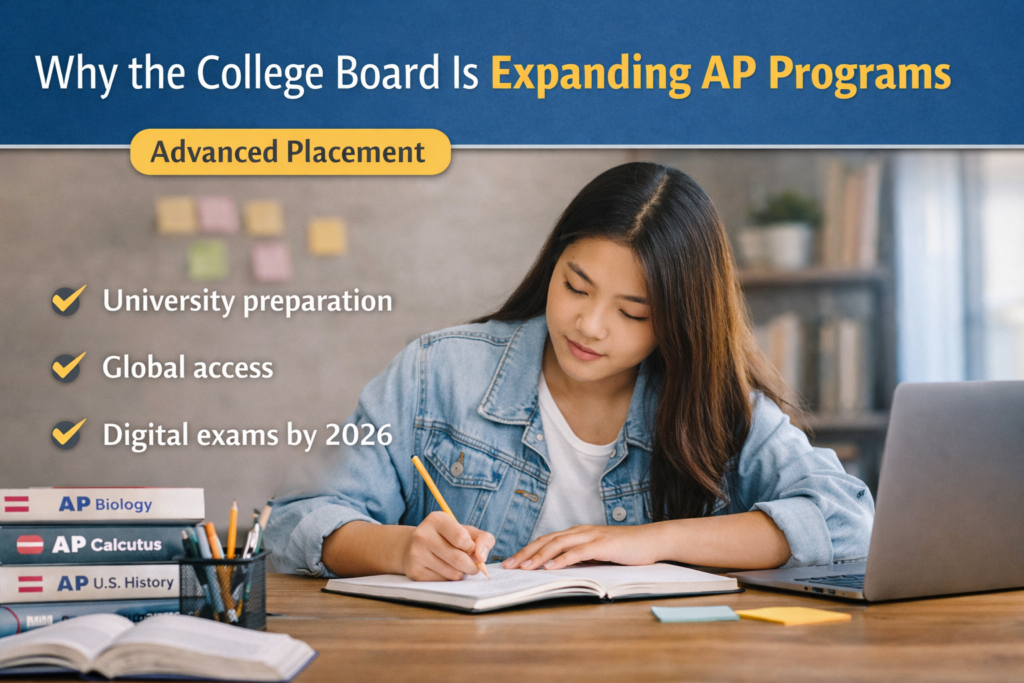
The College Board is working hard to grow AP, and it is growing quickly. Why? The simple answer is that universities are changing, education is changing, and students require additional means to demonstrate their ability to do college-level material. AP fills that gap perfectly.
In this blog, we will explain to you why the College Board is pushing to expand the AP and how it is important for you to understand everything about it.
What Is AP, Really?
Advanced Placement (AP) is an opportunity for high school students to study university-level subjects while still in school. At the end of each course, students take an AP exam (also called an Advanced Placement test) and are scored from 1 to 5.
A score of 3.5 or more is usually considered high and it can help you
- Earn college credit
- Skip introductory university courses
- Strengthen your university applications
- Show academic rigour to admissions officers
In simple terms, AP lets you prove you can handle college-level work early, sometimes saving both time and money later.
Why Is the College Board Expanding AP Now?
The expansion isn’t random. It’s happening because of real shifts in how universities evaluate students and how learning itself is evolving.
1. Preparing Students for Real College-Level Learning
One of the biggest reasons behind AP’s expansion is college readiness.
AP courses are designed to mirror university workloads. They help students build essential skills like:
- Critical thinking
- Academic writing
- Time management
- Deep subject understanding
When students arrive at university already familiar with this level of rigour, the transition is smoother and far less overwhelming.
2. Making AP More Inclusive
In the past, AP was limited to select schools or only top-performing students. The College Board is now actively working to change that.
Their goal is simple: any motivated student should have access to AP, regardless of background.
This includes:
- More schools worldwide are offering AP subjects
- Fee reductions for eligible students
- More international testing locations
This shift helps level the playing field and gives more students a fair chance to compete globally.
3. Digital AP Exams and Modernisation
By 2026, most AP exams will be offered in digital formats.
This move helps by:
- Making exams more secure
- Reducing administrative delays
- Improving accessibility for international students
For students outside the U.S., this is especially important. Digital exams reduce dependence on physical test centres and make global participation easier.
4. AP Is No Longer Just for the U.S.
AP is now globally recognized and the rise of AP in Singapore shows how international demand has grown. Students who are preparing themselves for top universities in the U.S., UK, Canada, and other countries are more focused towards AP.
Singapore, in particular, has become a key AP testing and preparation hub because of:
- Strong academic culture
- Reliable exam administration
- Easy access for students across Asia
AP Course Cost
One of the most common questions students ask is about cost.
- AP exam fee: Around USD 129 per subject
- Local test centre charges: In places like Singapore, total costs may range from USD 200 to 300 per exam
- AP course tuition: Varies depending on the school or coaching provider
Some students may qualify for fee reductions, which can significantly lower the exam cost.
Why AP Will Matter Even More in 2026
Universities are becoming more competitive every year. By 2026, AP will continue to matter because it:
- Shows readiness for demanding coursework
- Helps universities compare students from different education systems
- Highlights subject-specific strengths
AP in Singapore:
AP Singapore has become a popular choice for students who:
- Don’t have AP offered at their school
- Want globally recognised academic credentials
- Wish to apply to international universities
Singapore’s organised testing environment and strong academic standards make it a trusted destination for AP exams.
How The Princeton Review Singapore Can Help
Preparing for AP exams isn’t easy; you need experts to support you throughout your journey. We help our students ace AP exams by offering:
- Expert-led AP preparation
- Structured study plans and realistic practice tests
- Strategies focused on scoring high, not just finishing the syllabus
- Confidence-building guidance for first-time AP test takers
With the right guidance, students don’t just aim to pass — they aim to score well.
Conclusion
The College Board’s push to expand Advanced Placement isn’t accidental. It’s a response to how education is changing globally.
As we move closer to 2026, AP is becoming:
- More accessible
- More modern
- More internationally recognised
- More aligned with what universities actually want
For the best guidance and AP prep courses, trust The Princeton Review Singapore and reach out to us now.