
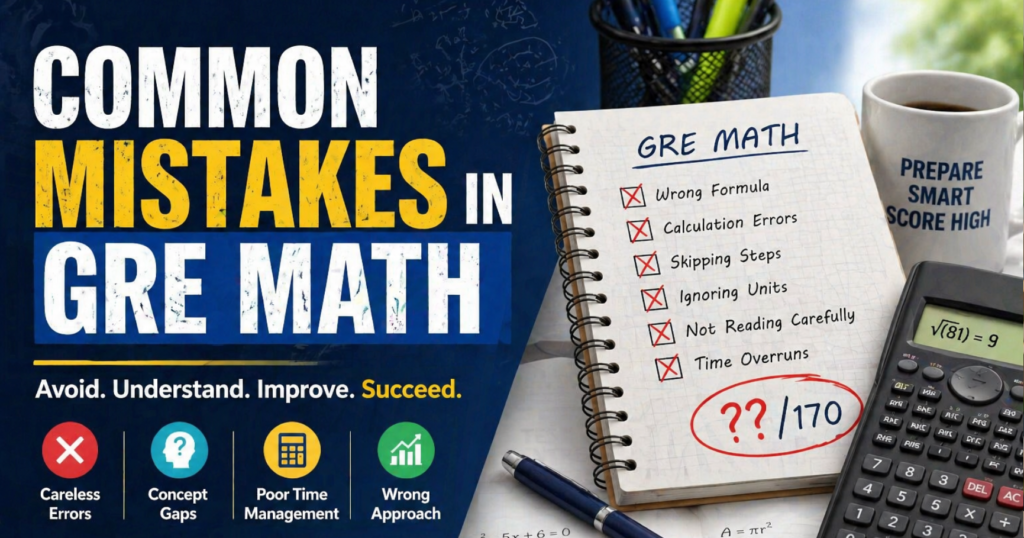
Here’s something nobody tells you when you start GRE prep: most of the points students lose in the Quant section have nothing to do with not knowing math. They know the formulas. They’ve done the practice problems. They take their seats on exam day, but the result remains below expectations.
Why? Because the GRE Mathematics examination not only assesses your knowledge. Rather, it assesses how well you can think under pressure, while time is ticking, and when three options seem to be almost the same. That gap between knowing and doing? That’s where most students bleed points.
Let’s talk about the real mistakes — not the obvious ones you’d find on any prep website, but the ones that quietly wreck scores.
The Most Common GRE Mistakes Students Make
1. Treating It Like a Speed Test
A lot of students walk into GRE preparation mode believing faster is better. So they rush.
But rushing doesn’t just increase speed—it reduces clarity. You skip steps, assume values, and suddenly a simple question turns into a wrong answer.
You omit steps, make assumptions, and before you know it, an easy problem becomes an incorrect solution.
I have watched students get questions wrong, even though they had done them flawlessly, simply because they attempted to solve them too fast in their tests.
What helps:
Find a rhythm instead of chasing speed. Accuracy first, pace later.
2. Reading What You Expect—Not What’s Written
This one is surprisingly common.
You read a question and fill in the blanks according to a familiar pattern. However, GRE problems often depend upon a single word: could, must, integer, or non-negative.
Miss that, and you’re solving a completely different problem.
A small habit that works:
Pause for a moment after reading. Ask yourself: What exactly is this question asking?
Also Read: GRE At-Home vs Test Centre in Singapore: Which Option Should You Choose in 2026
3. Assuming “Normal” Values
In school math, numbers usually behave nicely. On the GRE, they don’t have to.
If a variable is mentioned, it might be negative, zero, fractional, or anything unless restricted.
Students often forget this and jump to conclusions.
Example situation:
If a question involves a square root or square, there may be more than one valid value. Ignoring that possibility costs marks.
4. Doing More Work Than Necessary
A few GRE problems may appear difficult because of their length, but they do not really need lengthy solutions.
However, some test takers always feel that they need to do calculations in stages until they find an easier way to solve them.
Sometimes, plugging in values or testing answer choices is faster and safer.
A better approach:
Before solving, take a breath and scan for shortcuts.
5. Weak Basics (Even If You Don’t Notice It)
This one doesn’t always show up immediately.
You might understand advanced questions, but hesitate on fractions, percentages, or ratios. These small gaps slow you down and increase mistakes.
And because these topics feel “basic,” students often ignore them during GRE prep.
Reality check:
Strong fundamentals make everything else easier.
6. Poor Time Decisions
It is not just about rushing through problems on GRE Quant; it is about making judgments.
Three minutes spent on a difficult problem can seem justified, but that time will be stolen from other easy problems you will face later.
What differentiates the experienced GRE test-taker: They move on when needed. And they come back if time allows.
7. Overusing the Calculator
The on-screen calculator feels like a safety net. But it can slow you down more than you realize.
Typing errors, unnecessary dependence, and lost time all add up.
Many calculations are quicker to do mentally—especially simple ones.
8. Misreading Graphs and Tables
Data interpretation looks manageable until you’re in the exam.
Students often:
- Misread labels
- Ignore units
- Estimate incorrectly
And since these questions appear straightforward, mistakes here feel especially frustrating.
Tip:
Treat graphs like reading comprehension—carefully and line by line.
9. Small Calculation Errors
These are the quietest score killers.
You follow the right method, but a minor arithmetic slip changes the final answer. And because the logic was correct, the mistake often goes unnoticed.
One simple fix:
Write steps clearly. Messy work leads to messy results.
10. Practicing Without Reflecting
Solving many problems does not necessarily enhance your grade.
If you do not examine yourself on what went wrong, you may only make the same mistakes repeatedly.
This is one of the major reasons why most learners get stuck despite practicing frequently.
A smarter habit:
After each session, review a few mistakes deeply. That’s where real improvement happens.
How The Princeton Review Fits Into All of This
Knowing your mistakes and actually fixing them are two different things. The Princeton Review Singapore provides top GRE courses online, built specifically around the second part — the fixing.
Their instructors don’t just teach content. They teach the test: how questions are structured, what wrong answers are designed to trap, and where students consistently lose points. The strategies embedded in their curriculum address exactly the kinds of errors covered in this post. No matter if you choose an online self-paced study program or attend classes, your curriculum is designed around the actual exam, not some imitation of it. If you prefer a more planned approach and need professional assistance as opposed to being on your own, this is a good choice for you.
What This Actually Comes Down To
GRE Math rewards a specific kind of student — not the one who knows the most math, but the one who executes under pressure. Careless errors, misread questions, poor time allocation — these are learnable problems. They’re fixable with the right habits and enough deliberate practice.
The score you want is probably closer than you think. It just requires cleaning up the errors you’re already making, not learning entirely new material.
Frequently Asked Questions
Misreading question stems, skipping over key constraints like “must be true” versus “could be true,” arithmetic slips under time pressure, and poor pacing are the biggest culprits. Most of these aren’t gaps in knowledge — they’re execution errors. Students who recognize this early tend to improve faster because the fix is behavioral, not academic.
Usually, it’s a combination of test anxiety and moving too fast. When your brain is under pressure, it cuts corners — skipping steps, holding too much in working memory, second-guessing correct answers. The solution is counterintuitive: slow down slightly and write more down. Structured scratch work reduces the mental load that causes slips.
Read every question twice before touching your scratch paper. Write out your variable definitions in word problems. After solving, plug your answer back in and check units. Review every wrong answer in practice — including guesses you got lucky on — to understand what thought process led you there. Awareness precedes correction.
It might be even more crucial than you imagine. Being stuck on challenging questions for an extended period of time while hurrying to complete easier ones tends to be a pattern that always leads to poor grades. It doesn’t matter whether questions are difficult or simple since both are valued equally; therefore, securing those easier points is critical.
Number properties, word problems requiring equation setup, coordinate geometry, and data interpretation questions generate the most errors. These aren’t necessarily the hardest topics — they’re the ones that punish skimming and reward careful reasoning. Strong conceptual understanding in these areas makes a bigger difference than memorizing formulas.