
Let me paint a scene that probably sounds familiar.
You’re sitting with your phone or laptop, maybe a little jittery, maybe telling yourself you don’t care that much — and then the page loads. There’s the number. Your stomach does something weird. And for a second, you forget what you were even planning to do next.
That moment passes. And then real life kicks in.
Whether your score made you want to call your parents immediately or quietly close the laptop and stare at the ceiling — what matters now is knowing how to move forward. So let’s talk through this, step by step, like two people who’ve actually been through the college process and survived it.
First Things First — When and Where Do Scores Actually Appear?
The College Board usually releases scores roughly two to three weeks after your test date. And no, they don’t go on sale at midnight like concert tickets. They typically roll out in the morning or early afternoon — sometimes in batches — so if you check at 7 a.m. and nothing’s there, that’s normal.
Step-by-Step Process
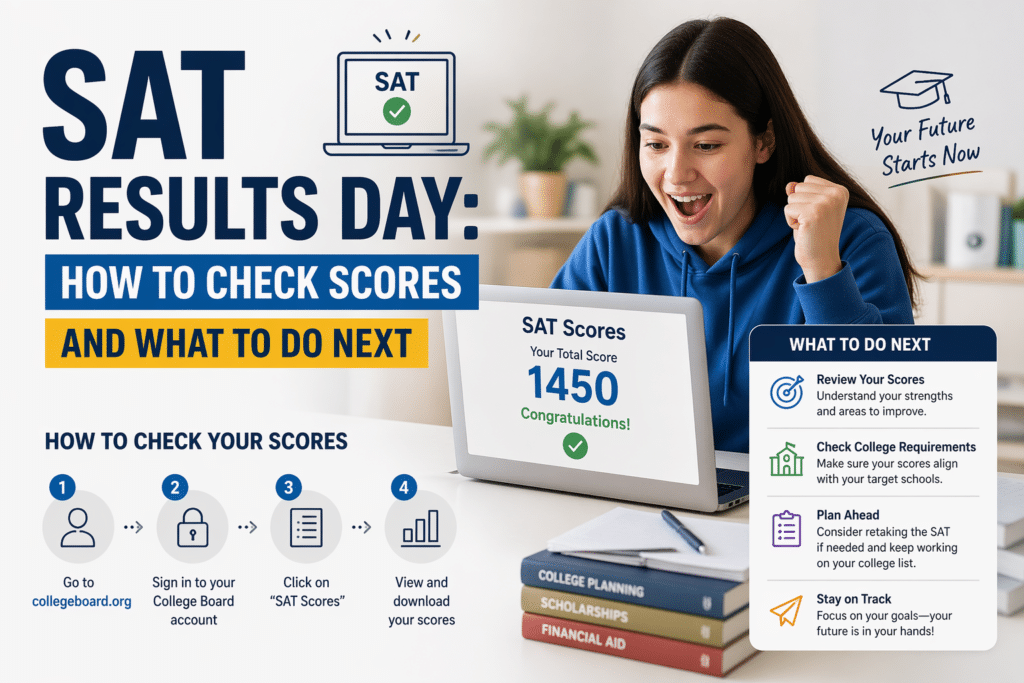
- Go to the official College Board website
- Log in using your registered email and password
- Click on the “My SAT” section
- Your scores will appear on the dashboard
If the page takes time to load—don’t panic. High traffic often slows things down on results day.
One thing that catches people out: ensure that you are signed in under the correct account. It has been known for students to inadvertently sign up for two accounts during registration, with different email addresses and passwords, and then sign in under the wrong one on results day, puzzled as to why there are no results.
Reading Your Score Report Without Getting Overwhelmed
When the results load, there’s more than just one number waiting for you. Here’s how to actually read what’s there.
Your Total Score
This is the number everyone talks about — scored on a scale of 400 to 1600. It’s the combination of two section scores.
The Two-Section Scores
Your Evidence-Based Reading and Writing (ERW) score and your Math score each go up to 800. A lot of people focus only on the total, but section scores matter too — especially if a particular school weighs one section more than another, or if you’re planning to retake and want to know where to focus.
Subscores (The Underrated Part of Your Report)
Buried beneath the main numbers are subscores that break your performance into smaller categories — things like “Heart of Algebra” or “Command of Evidence.” Most students skip past these entirely. Don’t.
If your math score was lower than expected, the subscores will tell you whether it was algebra dragging you down or problem-solving with data. That distinction completely changes how you study for a retake.
Percentile Rankings
Next to your score, you’ll see a percentile figure. If it says 78th percentile, that means you outperformed 78% of the reference group. This adds context that the raw score alone doesn’t give you. A 1310 sounds different when you realize it lands around the 83rd percentile, which is genuinely competitive for most schools.
What “Good” Actually Means (Hint: It Depends on Your List)
Here’s the thing nobody tells you directly enough: there is no single universal “good” SAT score. The benchmark shifts completely depending on where you want to go.
The most useful thing you can do is look up the middle 50% score range for each college on your list. This is the range between the 25th and 75th percentile scores of students they actually admitted. If your score sits in that range — or above it — you’re on solid footing. If it falls below the 25th percentile, that’s worth paying attention to.
Rough ballpark for context:
- Somewhere around 1100–1250 is solid for many regional four-year schools
- 1300–1450 is competitive for schools in the selective-but-not-hyper-selective range
- 1500 and above start to look strong at the most selective places in the country
These aren’t cutoffs. They’re just landmarks.
Okay, Scores Are Here — What Do You Actually Do Now?
If the Number Made You Smile
Nice. Go ahead and enjoy that for a minute.
Then get practical. If you haven’t sent your scores to colleges yet, do that through your College Board account. You’ll find the score sending option right there on your dashboard.
If the Number Made You Wince
Don’t sign up for the next test date out of panic. That’s what people do when they are being emotional rather than strategic, and it’s not likely to help you out.
Instead, spend a day or two away from the score report. Then come back to it fresh and actually read the subscores. Find the two or three areas that hurt you most, and start thinking about what preparation for those specific things would look like.
Also worth checking: how many of your target schools are test-optional? The list has grown significantly over the past few years. For some students, a strong application without a submitted score is genuinely the smarter play.
The Superscoring Thing — Actually Worth Understanding
If you’re going to retake the SAT, superscoring changes the math on how you approach it.
Here’s how that works: some colleges — quite a few selective ones- that use a system called “superscoring.” So if your March attempt gave you a 710 in Math and a 620 in Reading and Writing, and your May attempt gave you a 640 in Math and 690 in Reading and Writing, a school that superscores would combine your best: 710 + 690 = 1400.
That’s a better result than either individual sitting produced.
This matters for strategy because it means you don’t need to beat your previous total score — you just need to beat one section. Go in with a specific goal. If your ERW was the weak link, spend the weeks before your retake focused heavily there. Math doesn’t need to improve if it’s already your strong suit.
Just verify each school’s policy individually, because not every college superscores.
Should You Cancel? Rarely, Honestly
Score cancellation is one of those options that sounds more useful than it actually is. Here’s the catch: you have to decide before you see your results. Once you’ve viewed your score on the College Board’s website, cancellation is off the table.
And even if you could cancel after seeing them, it’s rarely the right call. Most schools either use Score Choice (meaning you pick which dates to share) or they superscore and focus on your best performance anyway. A weaker score from an earlier attempt generally doesn’t damage you when you’ve got a stronger one to show.
The only situation that cancellation might make any sense is if something really went wrong in testing, a health issue, a major distraction, something that really, really derailed your performance. Even then, seeing the score first generally tells you more than you’d guess.
How The Princeton Review Can Help You Actually Improve
If a retake is in your plans — or even if you’re preparing for a first attempt — the difference between sitting down to study randomly and having an actual structure matters more than most students expect.
The Princeton Review has been doing this long enough to know exactly where the SAT trips students up, and more importantly, why. We start with a diagnostic that’s designed to find your specific gaps — not just “math is hard” but “you’re losing points on geometry and data interpretation specifically.” That kind of precision makes study time actually count.
We have options that work best for various situations, whether that’s self-paced online courses for students who need flexibility, live online classes with real instruction for students who are more effective learners in a classroom, or one-on-one tutoring for students who prefer a more personal approach. Tutors aren’t just there to give students tricks; they’re there to give students instruction, and that’s what’s going to help students retain what they’ve learned, rather than just what’s going to help them get through the test.
If students want to go into their retake with a clear mind and a solid plan, The Princeton Review is one of the most obvious ways to do so.
Score Sending — The Logistics Matter
When you registered, you received four free score sends — four colleges you could designate to receive your results at no charge, as long as you named them before your test date. After that window, it costs a small fee per additional school.
The College Board’s Score Choice policy lets you decide which test dates to send to most schools. That said, some colleges require you to submit scores from every sitting, not just your best one. Before you decide what to send where, look up each school’s official policy — it’s usually listed in their admissions FAQ or testing requirements page.
Understand Your Digital SAT Report
Most of the time, your score reflects your performance accurately. But if something feels off — for example, your result is dramatically different from your consistent practice scores (we’re talking 150–200 points lower with no clear reason) — it’s important to know your options.
For the Digital SAT, traditional hand-score verification from the old paper-pencil format no longer applies in the same way. Since the test is taken digitally, answers are recorded directly, which significantly reduces the chances of scanning or processing errors.
However, you can still review your score report in detail. The report provides insights into your performance across domains, helping you identify whether the score aligns with your expectations. If there’s a major discrepancy, it’s worth carefully analyzing your test-day performance, timing, and conditions.
While score changes are extremely rare, understanding how your score is calculated — and reviewing your report thoroughly — is the best first step if something doesn’t seem right.
The Part Nobody Really Says Out Loud
The SAT is a standardized measure. It checks particular things in particular ways. It doesn’t test how interesting you are as a person, how hard you have worked, what you are going to do with your life, or whether you are going to be a good fit at a particular school.
Colleges use it because it provides them with a single data point among tens of thousands of applications. That’s the extent of what it is.
A strong score helps. It opens some doors that are otherwise harder to open. But a score that didn’t land where you hoped doesn’t close anything permanently — not if you respond with clarity and some honest effort.
Look at your actual numbers. Check them against your actual school list. Make a plan that’s based on real information, not anxiety. And then keep going.
That’s the move. Every time..