
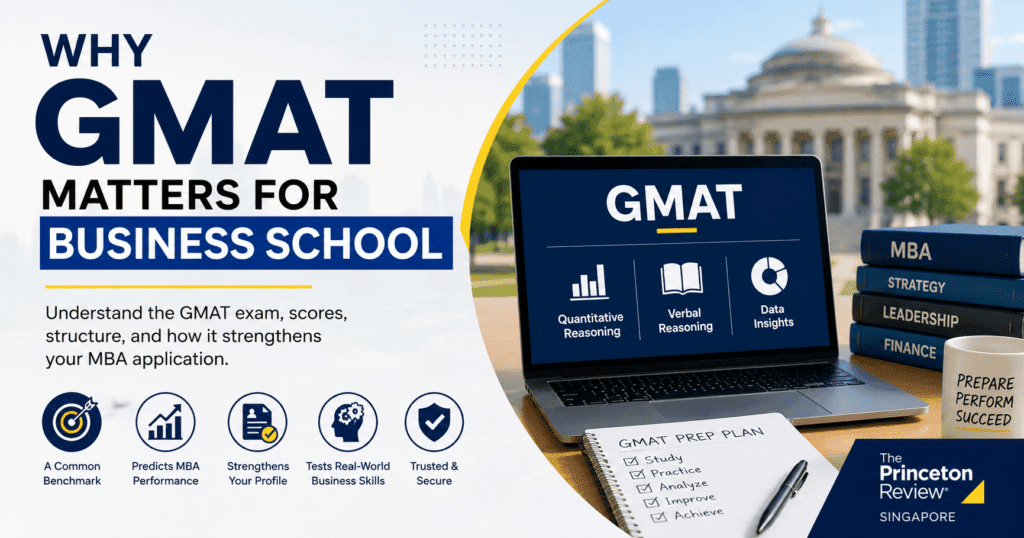
The first thing you will notice if you are considering going to business school is the ubiquitous term GMAT. It appears on many university websites, numerous MBA forums, on numerous LinkedIn profiles, and almost all major university MBA applications list GMAT as a required credential. What is so significant about the GMAT? Why is it so overwhelmingly significant to most of the top-tier graduate business schools?
Let us clarify this issue without having to suffer from all of the jargon that surrounds it.
Why Business Schools Value the GMAT Exam
Business schools receive applications from students with very different academic backgrounds — engineers, economists, artists, consultants, and entrepreneurs. Comparing GPAs alone isn’t enough.
This is where the GMAT exam becomes useful.
1. A Common Benchmark for All Applicants
No matter where you studied or what system your university followed, the GMAT puts everyone on the same scale. It helps schools fairly compare candidates from different countries and education systems.
2. Predicts MBA Classroom Performance
The GMAT test is built to reflect real MBA challenges:
- Complex data analysis
- Time-pressured decision making
- Critical reasoning
Students who perform well on the GMAT tend to adapt faster to business school coursework, which is exactly what admissions committees want.
3. Strengthens Your Application Profile
A strong GMAT score can:
- Compensate for a lower GPA
- Strengthen applications from non-business backgrounds
- Make your profile more competitive at top schools
For many applicants, the GMAT is what pushes their application from “average” to “serious contender.”
GMAT Test Structure
The exam has 3 sections, each scored from 60–90:
| Section | Score Range |
| Quantitative Reasoning | 60-90 |
| Verbal Reasoning | 60-90 |
| Data Insights | 60-90 |
The adaptive nature of the GMAT means the test adjusts to your performance, making strategy just as important as knowledge.
What Is a Good GMAT Score?
Total Score
- Range: 205–805
- Score increments: 10 points
- Average score: Around 545–555
For competitive MBA programs:
- 600+: Generally competitive for many good business schools.
- 655–705+: Strong score for top international MBA programs.
- 735+: Excellent score, often competitive for elite programs such as Harvard Business School, Stanford Graduate School of Business, and The Wharton School (though admissions depend on much more than GMAT).
What Is a GMAT Certificate?
The GMAT certificate is something you receive after completing your GMAT test and can be sent directly to business schools.
Key points:
- GMAT scores are valid for 5 years
- You can choose which scores to send to schools
- Universities receive scores directly from the GMAT system
This makes the process secure and standardized.
Why GMAT Still Matters in the Age of AI
With AI tools becoming more advanced, universities are more cautious about grades and essays. The GMAT exam remains valuable because:
- It’s proctored and secure
- AI cannot take the test for you
- It measures real-time thinking and reasoning
That’s why many business schools still trust the GMAT as a reliable indicator of readiness.
Best GMAT Practice Tests:
The best GMAT practice tests help you:
- Understand the real exam format
- Build timing and stamina
- Identify weak areas early
- Reduce exam-day anxiety
High scorers don’t just study concepts — they practice under realistic conditions again and again.
How The Princeton Review Singapore Helps with GMAT Prep
Preparing for GMAT on your own can feel overwhelming — especially if you’re balancing work, internships, or final-year studies.
This is where The Princeton Review Singapore makes a real difference.
We support GMAT aspirants through:
- Expert-led GMAT preparation by experienced instructors
- Access to some of the best GMAT practice tests available
- Personalised study plans based on your target score
- Skill development and strategy guidance
- Focused preparation for students aiming for a 700+ GMAT score
Conclusion
So, why does GMAT matter for business school?
Because it:
- Creates a fair comparison between applicants
- Predicts success in MBA classrooms
- Strengthens your overall application
- Remains trusted even as AI changes education
For smart preparation, trust the Princeton Review Singapore and achieve your target scores with our guidance.