
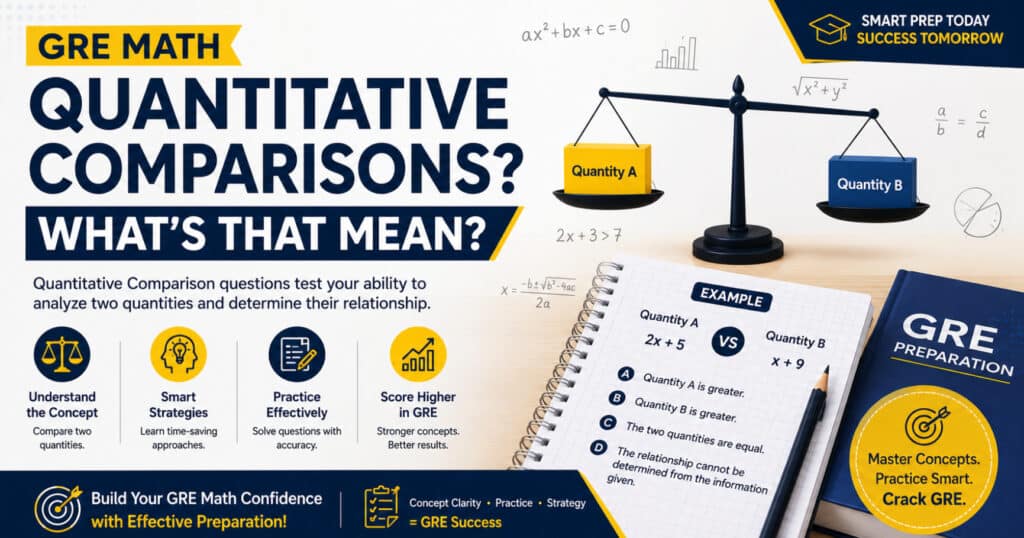
You’re scanning the GRE math section for the first time, moving through question types, and then you hit this one: Quantitative Comparisons. It sounds like a corporate buzzword. What are you comparing? Against what?
Two columns. Each one has a math expression. Your job is figuring out which is larger — or if they’re equal — or if there’s genuinely no way to know from what you’ve been given. You’re not solving for a number. You’re making a call about how two things relate to each other.
That sounds easy. And the math usually is. What trips people up is the reasoning, which runs differently from every other question type on the GRE.
What the Question Actually Looks Like
The layout never changes. Column A on the left, Column B on the right. Sometimes there’s a condition sitting above both — “x is a positive integer,” “n > 2,” something along those lines. That condition isn’t just scene-setting. On a lot of problems, it’s the whole ballgame.
Four answer choices, always the same four:
- Column A is greater
- Column B is greater
- The two quantities are equal
- The relationship cannot be determined from the information given
What’s absent from that list is any specific number. You won’t write “14” or “2.7.” The question is purely relational — bigger, smaller, equal, or unknowable. Students who go hunting for a numerical answer spend a lot of unnecessary time and still miss the point.
Why ETS Designed This Format
Fast arithmetic isn’t what graduate programs are hiring for. A student who charges through every problem with computation is going to struggle here, because QC questions were built to reward a different instinct entirely.
The format tests whether you can look at two expressions and reason about their relationship without necessarily working them out. A question answerable in twenty-five seconds through logic might take three minutes if you try to brute-force it. ETS knows this, and the time pressure is deliberately calibrated around the efficient path — not the computational one.
QC problems make up roughly a third of your Quant questions. That’s a big chunk of your GRE math score, and they’re not the place to discover mid-test that you’ve been solving them the hard way.
Also Read: Common Mistakes in GRE Math
An Example Worth Walking Through
Condition: x is a positive integer
Column A: x²
Column B: x³
Natural first move: plug in x = 2. Column A gives 4, Column B gives 8. B is bigger — looks like a clear win for B.
But then try x = 1. Column A: 1. Column B: also 1. Suddenly they’re equal.
With x = 2, B wins. With x = 1, they tie. Two different values, two different outcomes. That’s a contradiction, which makes D the correct answer — the relationship can’t be pinned down because it changes depending on what x is.
One example pointing toward B isn’t proof that B always wins. What you’re actually hunting for is whether the relationship holds every single time, or whether you can find two cases that point in opposite directions. If you can find the contradiction, D is your answer. If you genuinely can’t, you need to understand algebraically why you can’t — that algebraic reasoning is your actual proof.
Answer D: Not a Bailout
When students hit a QC problem they can’t crack, a lot of them gravitate toward D. Stuck? Can’t tell? Mark “cannot be determined” and keep moving. This burns people badly.
D requires evidence. Specifically, it requires finding two scenarios that produce different results — like the x² vs. x³ example above. Without that, D is a guess, not a conclusion.
The flip side is also true: testing five values and getting Column A every time isn’t enough to mark A with confidence. You’d still need to pin down why A always comes out ahead. Usually, that means seeing an algebraic relationship — something that explains the result structurally rather than just empirically.
A practical way to work these: try to find a case where one column beats the other. Then try hard to reverse it. If you can reverse it, you’re done — answer D. If you can’t reverse it despite real effort, figure out the reason you can’t, and that reason is your justification for A, B, or C.
The Math Underneath
QC problems draw from the same four areas as the rest of GRE quant — arithmetic, algebra, geometry, data analysis — but each area has tendencies worth knowing ahead of time.
In algebra problems, whether a variable is positive, negative, or zero is almost always the crux. Expressions that behave one way for positive integers do something completely different for fractions or negatives. A condition like “x > 0” is a signal: this problem was designed around what changes when you can and can’t use negatives. Read it carefully.
Geometry QC problems typically pit areas, angles, or side lengths against each other. The single biggest mistake here is reading the diagram as though it were drawn to precise specifications. GRE diagrams are explicitly illustrative — that triangle that looks like a 45-45-90 might have completely different angles. Unless the problem states a measurement outright, it’s not guaranteed.
For arithmetic problems involving exponents, roots, or absolute values, simplification usually unlocks the comparison. If both columns can be expressed in the same form or the same base, the question almost answers itself. Jumping into computation before simplifying is where most of the wasted time goes.
Data analysis questions in this format often ask you to compare a mean to a median, or contrast probabilities under different conditions. Calculation matters less here than understanding what shapes a distribution — why a cluster of high outliers pulls the mean above the median, for instance. Knowing the concept beats grinding through arithmetic.
A Few Approaches That Hold Up
Cancel shared terms — carefully. If both columns contain the same value, you can remove it from both sides and compare what’s left. Addition and subtraction: fine. Multiplication and division: only safe if the shared term is definitely positive. Cancelling a negative value flips the inequality. If the sign is uncertain, leave it alone.
Get both sides into the same form before comparing. Rather than computing Column A all the way to a number, then Column B all the way to a number, see if you can rewrite both sides to look more alike. Factor one. Expand the other. Find a common base. The comparison usually becomes obvious before you’ve done any real arithmetic.
Test the values that behave differently. If a variable is unconstrained, run x = 0, x = 1, x = −1, and x = ½. These four catch the vast majority of reversals. Zero doesn’t behave like positive integers. Fractions between 0 and 1 shrink when you raise them to higher powers, which is the opposite of what happens with integers greater than 1. Negatives flip inequalities. A test set of only x = 2, 3, 4 is telling you almost nothing useful.
Slow down on the condition. Whatever appears above the two columns deserves more attention than most students give it. “n is an odd integer greater than 1” eliminates evens, eliminates 1, and shapes the entire problem. The condition is there because the question was designed around it. Glancing at it and moving on is how you solve the wrong problem.
Where People Go Wrong
The geometry trap is persistent: students see a shape that looks a certain way and treat that appearance as data. A quadrilateral with what appear to be right angles might not have any. Without explicit measurements in the problem, visual intuition doesn’t count.
Skipping fractions when testing values is probably the most common individual mistake. Whole numbers are comfortable, so that’s what people test. But fractions between 0 and 1 change how exponents work in ways that directly affect whether columns flip. Squaring ½ gives ¼ — smaller, not larger. Any problem where the variable could be a non-integer deserves at least one fractional test case.
Long, ugly arithmetic is usually a wrong turn signal. QC questions are scored the same as every other question, but they’re designed with a faster path in mind. When the computation gets complicated, it almost always means there’s a simpler angle that got missed at the start.
Fitting QC Into Your Study Plan
Because QC problems make up roughly a third of your Quant questions, weak performance here compounds. It’s not a niche skill — it’s a format you’ll see repeatedly, and consistent errors add up fast.
The actual math content isn’t the learning curve. Most people already know enough algebra and arithmetic to handle what these questions ask. What takes time to develop is the comparison mindset: reading the condition first, resisting the urge to compute immediately, testing the right values, knowing what actually justifies answer D. That doesn’t happen from reading about it. It comes from doing sets, reviewing the problems where the reasoning went sideways, and asking specifically where the thinking broke down, rather than just checking what the right answer was.
Ten QC problems per session, reviewed closely, beats fifty problems skimmed.
How The Princeton Review Singapore Can Help
Most prep courses drop problems in front of you and call it practice. The Princeton Review Singapore does something more useful: they teach how ETS writes questions. For QC, that distinction matters more than in almost any other format.
Understanding why certain wrong answers are engineered to attract certain mistakes — why “cannot be determined” sits there as an option, why the condition is worded the way it is — changes how you read problems. You stop being reactive and start recognising patterns before you’ve finished the question. That’s not something that comes from drilling problems blind.
Our GRE preparation courses include adaptive practice, full-length tests built to match the real exam’s section-adaptive structure, and enough problem volume that you won’t exhaust the material before test day. For students whose QC scores are inconsistent, working with one of their tutors to target exactly that format is often a faster fix than general practice. Our free resources — sample questions, score range estimators, subject guides — give you a real preview of their teaching approach before any money changes hands.
What It Really Comes Down To
Quantitative Comparisons aren’t a harder category of math problem. They’re a different kind of question entirely — one that rewards stepping back before diving in.
Strong QC performance comes from reading conditions with actual care, choosing test values that stress-test assumptions rather than confirm them, and treating D as something to be proven rather than guessed. None of those things requires special mathematical ability. They require practice with the specific habits this format demands.
Start without the clock. Do a set, review every single wrong answer for the exact place your reasoning slipped, adjust, repeat. Timed pressure comes later, once the approach is solid. Trying to build speed before the reasoning is reliable just locks in the wrong instincts faster.